
Quick Answer: SEO — Search Engine Optimization — is the process of making your website show up on Google when people search for your products or services. It is one of the most powerful and cost-effective ways to grow your business online. Instead of paying for every click like you do with ads, SEO brings in free, consistent traffic from people who are already looking for exactly what you offer. In 2026, if your business is not investing in SEO, you are handing customers directly to your competitors.
Contents
- 1 The Question Every Business Owner Asks
- 2 What is SEO? The Simple Explanation
- 3 How Does SEO Work? Inside Google’s Brain
- 4 Why Does Your Business Need SEO? The Real Answer
- 5 SEO vs Paid Ads — What is the Difference?
- 6 Types of SEO — What They Are and Why They Matter
- 7 How Long Does SEO Take to Show Results?
- 8 The Real Benefits of SEO for Your Business
- 9 Common SEO Mistakes That Kill Your Rankings
- 10 How to Get Started With SEO for Your Business
- 10.1 Step 1 — Set Up Google Search Console and Analytics
- 10.2 Step 2 — Optimize Your Google Business Profile
- 10.3 Step 3 — Do Keyword Research
- 10.4 Step 4 — Optimize Your Website Pages
- 10.5 Step 5 — Create Consistent, Quality Content
- 10.6 Step 6 — Build Backlinks
- 10.7 Step 7 — Work With an SEO Professional
- 11 What is SEO Like in 2026? What Has Changed?
- 12 Final Thoughts — Is SEO Worth It for Your Business?
- 13 Frequently Asked Questions About SEO
The Question Every Business Owner Asks
At some point, every business owner types the same thing into Google: what is SEO? Maybe a friend mentioned it. Maybe you noticed your competitor showing up on page one while your website sits somewhere on page five. Maybe you have been running ads and wondering if there is a way to get traffic without paying for every single click.
The answer to all of that is SEO — Search Engine Optimization. And if you are a business owner in 2026 who is serious about growing online, understanding what SEO is and why your business needs it is not optional. It is essential.
This guide breaks it all down in plain language. No technical jargon. No confusing acronyms. Just a clear, honest explanation of what SEO is, how it works, and why it might be the single most important investment your business makes this year.
What is SEO? The Simple Explanation
Let’s start with the basics. What is SEO? SEO stands for Search Engine Optimization. It is the practice of improving your website so that it appears higher in search engine results — primarily Google — when someone searches for something related to your business.
Think about the last time you searched for something on Google. You typed a few words, hit enter, and a list of results appeared. You probably clicked one of the first three results. You almost certainly never went to page two.
That is exactly what SEO is about. Getting your website into those top positions so that when your ideal customer searches for what you offer — they find you first, not your competitor.
In simple terms: SEO is the art and science of making Google trust your website enough to show it to people who are looking for what you do.
What Does SEO Actually Stand For?
S — Search: The search queries people type into Google every day
E — Engine: Google — the platform that processes billions of searches
O — Optimization: The process of making your website better so Google ranks it higher
Put it together and SEO means making your website better so search engines rank it higher so more people find your business online. That is it.
How Does SEO Work? Inside Google’s Brain
Google’s job is to give people the best possible answer to their question as fast as possible. To do that, Google sends out little programs called crawlers — think of them as tiny robots — that scan every website on the internet.
These crawlers look at your website and try to understand what it is about, how trustworthy it is, how fast it loads, whether it works on mobile, and whether other websites consider it worth linking to.
Based on all of this, Google gives your website a score for any given search query. The websites with the highest scores show up first. The ones with lower scores get buried on page two, three, or never found at all.
SEO is the process of improving all of those factors so Google scores your website higher — and shows it to more people.
The 3 Pillars of SEO
1. Technical SEO — Making your website fast, mobile-friendly, secure (HTTPS), and easy for Google to crawl and understand
2. On-Page SEO — Optimizing the content on each page — including titles, headings, keywords, images, and meta descriptions — so Google knows what each page is about
3. Off-Page SEO — Building your website’s authority and trustworthiness through backlinks — when other credible websites link back to yours
All three work together. A website that loads fast but has no content will not rank. A website with great content but no backlinks will struggle. The best SEO strategy addresses all three consistently over time.
Why Does Your Business Need SEO? The Real Answer
Now that you know what SEO is, here is the more important question: why does your specific business need it?
The honest answer is that your customers are already searching for what you offer. Right now. Every single day. The question is not whether they are searching — it is whether they are finding you or your competitor when they do.
The Numbers Tell the Story
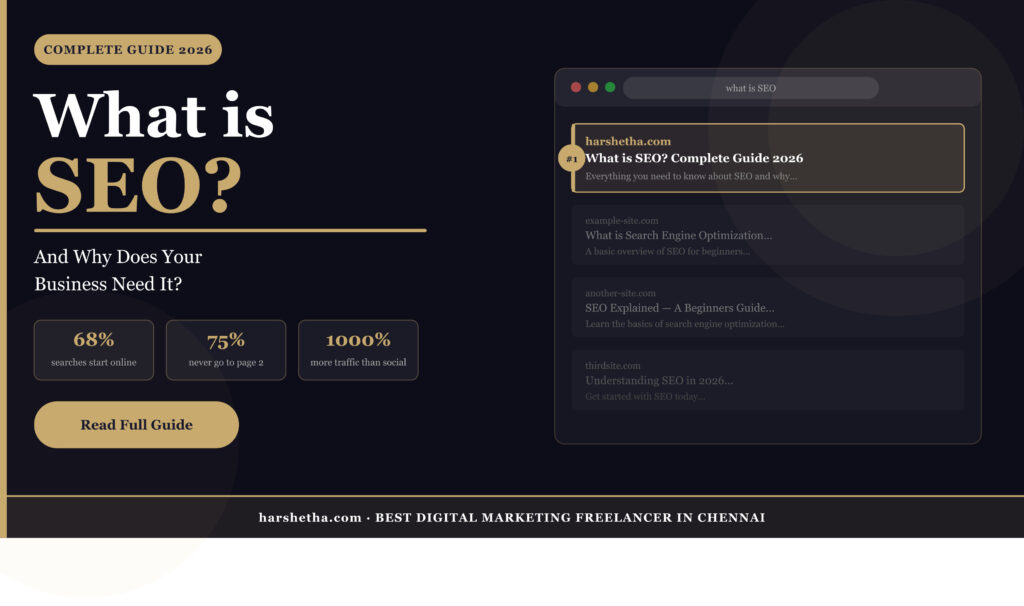
- 68% of all online experiences begin with a search engine — BrightEdge, 2023
- 75% of users never scroll past the first page of Google results — Search Engine Journal
- The first organic result on Google gets an average click-through rate of 27.6% — Backlinko, 2024
- India has over 759 million internet users actively searching every day — DataReportal, 2024
- 46% of all Google searches have local intent — people looking for businesses near them — Google
- SEO drives 1000% more traffic than organic social media — BrightEdge
These numbers make one thing very clear. SEO is not a nice-to-have. It is where your customers are. And if you are not showing up when they search — someone else is getting that business.
SEO vs Paid Ads — What is the Difference?
This is one of the most common questions business owners ask. Should I invest in SEO or just run Google Ads?
The answer is ideally both — but understanding the difference helps you prioritize.
Paid Ads — The Tap
Paid ads are like a tap. When you turn it on — by paying — traffic flows in. The moment you turn it off — by stopping payment — the traffic stops completely. There is no lasting benefit once you stop spending.
SEO — The Well
SEO is like digging a well. It takes time and effort upfront. But once it is built, it keeps producing water — free, consistent traffic — without you having to pay for every drop. A well-optimized page can bring in thousands of visitors every month for years without spending a single rupee on ads.
Both have their place. Paid ads give you immediate results. SEO builds long-term, compounding value. The smartest businesses use both together — ads for quick wins while SEO builds the foundation for sustainable growth.
Types of SEO — What They Are and Why They Matter
1. Local SEO
Local SEO helps your business show up when someone nearby searches for your type of service. When someone searches ‘digital marketing freelancer near me’ or ‘best restaurant in Anna Nagar’ — local SEO is what puts you in those results and on Google Maps.
For any business with a physical location or a local service area, local SEO is one of the highest-return investments available. 78% of local mobile searches result in an offline purchase or contact within 24 hours (Google).
2. On-Page SEO
On-page SEO is everything you do on your actual website pages — optimizing your titles, headings, content, images, and internal links. It tells Google exactly what each page is about and who it should be shown to.
3. Technical SEO
Technical SEO is the behind-the-scenes work — making sure your website loads fast, works perfectly on mobile, has no broken links, and is structured in a way Google can easily understand. Without a strong technical foundation, even the best content will struggle to rank.
4. Off-Page SEO
Off-page SEO is about building your website’s authority and reputation across the internet. The most important factor is backlinks — when other trusted websites link to yours. Think of each backlink as a vote of confidence that tells Google your website is trustworthy and worth ranking higher.
5. Content SEO
Content SEO is the creation of high-quality, relevant content — blog posts, guides, FAQs, and landing pages — that answers the questions your target audience is searching for. Great content is the foundation of every successful SEO strategy.
How Long Does SEO Take to Show Results?
This is the question everyone asks and deserves an honest answer.
SEO takes time. There is no shortcut. Anyone who promises you page one rankings in two weeks is either lying or using tactics that will get your website penalized by Google later.
Here is a realistic timeline:
- Month 1 to 2 — Technical fixes, keyword research, on-page optimization. Foundation building.
- Month 2 to 3 — Content creation begins. Early improvements in rankings for lower competition keywords.
- Month 3 to 6 — Meaningful traffic growth begins. Rankings for target keywords improve noticeably.
- Month 6 to 12 — Significant organic traffic. Consistent leads from search. Compounding results begin.
- Month 12 and beyond — Strong rankings, consistent traffic, and SEO becomes your most cost-effective marketing channel.
The key is consistency. SEO is not a one-time project — it is an ongoing strategy. But the businesses that commit to it for 12 months or more see results that paid advertising simply cannot match over the long term.
The Real Benefits of SEO for Your Business
1. Free, Consistent Traffic
Once your pages rank, the traffic they bring is completely free. Unlike paid ads where you pay for every click, SEO delivers traffic 24 hours a day, 7 days a week — without a ongoing cost per visitor.
2. Builds Trust and Credibility
When your business appears at the top of Google, visitors automatically trust you more. People associate high Google rankings with legitimacy and authority. Ranking well builds your brand’s credibility before a visitor even clicks your link.
3. Targets People Who Are Already Looking
Unlike social media ads that interrupt people who were not looking for you, SEO targets people at the exact moment they are actively searching for what you offer. This is the highest-intent traffic possible — people who are ready to buy.
4. Long-Term Return on Investment
A well-optimized page can rank and bring in traffic for years. The ROI of SEO compounds over time — the longer you invest, the more value you get. This is fundamentally different from paid ads where the value ends the moment you stop paying.
5. Competitive Advantage
Most of your competitors have not invested seriously in SEO. The businesses that do — consistently, over time — build a significant advantage that is very hard for competitors to close. Once you own page one for your key terms, maintaining that position is much easier than winning it.
6. Works With Every Other Marketing Channel
SEO amplifies everything else you do. Your social media posts drive traffic to your website. Your ads land on well-optimized pages. Your content gets found organically. A strong SEO foundation makes every other marketing channel more effective.
Common SEO Mistakes That Kill Your Rankings
Knowing what not to do is just as important as knowing what to do. Here are the most common SEO mistakes businesses make:
- Keyword stuffing — repeating keywords so many times it reads unnaturally. Google penalizes this.
- Ignoring mobile optimization — over 70% of web traffic in India comes from mobile devices. If your site is not mobile-friendly, you will not rank.
- Slow loading speed — Google uses page speed as a ranking factor. Slow sites lose rankings and visitors.
- No Google Business Profile — for local businesses, not having a Google Business Profile means missing out on Google Maps rankings entirely.
- Copying content — duplicate content confuses Google and hurts rankings. Every page needs original, unique content.
- No internal linking — linking between your own pages helps Google understand your site structure and keeps visitors engaged longer.
- Ignoring analytics — if you are not measuring what is working, you cannot improve it.
How to Get Started With SEO for Your Business
Getting started with SEO does not have to be overwhelming. Here is a simple roadmap for any business:
Step 1 — Set Up Google Search Console and Analytics
These two free tools from Google tell you exactly how your website is performing in search — what keywords you rank for, how many clicks you get, and what pages are performing best. Set these up before anything else.
Step 2 — Optimize Your Google Business Profile
If you serve local customers, claiming and optimizing your Google Business Profile is the fastest SEO win available. Fill in every field, add photos, collect reviews, and post regularly. This directly impacts your Google Maps rankings.
Step 3 — Do Keyword Research
Find out exactly what words and phrases your target customers type into Google when looking for your products or services. Use free tools like Google Keyword Planner or Ubersuggest to identify high-value keywords to target.
Step 4 — Optimize Your Website Pages
Make sure every important page on your website has a clear title tag, a compelling meta description, proper heading structure, and content that genuinely answers what your target customer is searching for.
Step 5 — Create Consistent, Quality Content
Start a blog. Write articles that answer the questions your customers are asking. Every piece of content is an opportunity to rank for a new keyword and bring in a new type of visitor.
Step 6 — Build Backlinks
Reach out to local directories, industry websites, and partners who might link to your site. Every quality backlink strengthens your domain authority and improves your rankings across all keywords.
Step 7 — Work With an SEO Professional
If all of this feels like a lot — that is because it is. SEO is a full-time discipline. Many businesses get the best results by working with a specialist. Harshetha at harshetha.com, for example, offers complete SEO services for small businesses and startups — from technical audits to content strategy and local SEO optimization.
What is SEO Like in 2026? What Has Changed?
SEO in 2026 is smarter, faster, and more competitive than ever. Google’s algorithm now uses artificial intelligence to understand search intent — not just keywords. Here is what matters most right now:
- Search intent matters more than keywords — Google wants to know WHY someone is searching, not just WHAT they typed
- E-E-A-T is critical — Google prioritizes content from real experts with real experience (Experience, Expertise, Authoritativeness, Trustworthiness)
- AI search is growing — tools like Google SGE, ChatGPT, and Perplexity are changing how people find information. Well-structured content ranks in both traditional and AI search
- Core Web Vitals — Google measures how fast your page loads, how stable it is, and how quickly it responds to user input
- Mobile-first indexing — Google primarily uses the mobile version of your website for ranking decisions
- Voice search — more people are searching by speaking than typing. Content written in natural conversational language ranks better for voice queries
The good news is that the fundamentals of SEO have not changed — quality content, strong technical foundations, and genuine authority still win. What has changed is how sophisticated Google has become at recognizing and rewarding them.
Final Thoughts — Is SEO Worth It for Your Business?
The answer is yes. Without question. SEO is one of the most powerful long-term investments any business can make in its online presence.
Yes, it takes time. Yes, it requires consistent effort. But the businesses that invest in SEO today are the ones that own page one tomorrow — and enjoy free, consistent, high-intent traffic for years to come while competitors keep paying for every single click.
Whether you are a small business just getting started or an established brand looking to grow — SEO is the foundation that makes everything else work better.
If you are ready to start but not sure where to begin, working with an experienced professional makes all the difference. Harshetha at harshetha.com specializes in SEO, Meta Ads, and web development for small businesses — helping them get found online, generate consistent leads, and grow without the guesswork.
Your customers are searching for you right now. The only question is — when they search, do they find you? If the answer is not a confident yes — it is time to invest in SEO.
Frequently Asked Questions About SEO
1. What is SEO in simple words?
SEO — Search Engine Optimization — is the process of improving your website so it shows up higher on Google when people search for your products or services. The higher you rank, the more people find your business — for free.
2. Why does my business need SEO?
Because your customers are already searching on Google for what you offer. If your website does not show up in those results, they go to your competitor instead. SEO puts your business in front of the right people at the exact moment they are ready to buy — without paying for every click.
3. How long does SEO take to show results?
Most businesses see early improvements in 2 to 3 months and significant results in 4 to 6 months. Competitive industries may take longer. SEO is a long-term strategy — but once you rank, the traffic keeps coming for free month after month without additional cost.
4. What is the difference between SEO and paid ads?
Paid ads give you immediate traffic but stop the moment you stop paying. SEO takes longer to build but creates lasting, free traffic that compounds over time. The smartest strategy uses both — ads for quick results while SEO builds the long-term foundation.
5. How much does SEO cost?
SEO costs vary depending on whether you do it yourself or hire a professional. Most experienced SEO freelancers in India charge between Rs 8,000 and Rs 25,000 per month. This is significantly cheaper than paid ads over the long term, especially when you factor in the compounding value of organic rankings.
6. What is local SEO?
Local SEO helps your business show up when someone nearby searches for your type of service — on Google Maps or with location-based queries. It is essential for any business with a physical location or local service area. 78% of local mobile searches result in an offline purchase within 24 hours.
7. What is a keyword in SEO?
A keyword is the word or phrase someone types into Google when searching for something. For example, ‘best digital marketing freelancer in Chennai’ is a keyword. SEO involves identifying the keywords your target customers use and optimizing your website to rank for those specific terms.
8. What is on-page SEO?
On-page SEO refers to all the optimizations you make directly on your website pages — including title tags, meta descriptions, headings, content, images, and internal links. It tells Google what each page is about and helps it rank for the right search queries.
9. What is off-page SEO?
Off-page SEO refers to everything done outside your website to improve its authority and trustworthiness — primarily building backlinks from other credible websites. Each quality backlink acts as a vote of confidence that tells Google your website is worth ranking higher.
10. What is technical SEO?
Technical SEO covers the behind-the-scenes aspects of your website — page speed, mobile-friendliness, HTTPS security, crawlability, and site structure. Without a strong technical foundation, even the best content will struggle to rank on Google.
11. Is SEO still relevant in 2026?
More than ever. With over 8.5 billion searches happening on Google every single day, SEO remains the most powerful way to get your business in front of people who are actively looking for what you offer. AI search tools have made quality SEO content even more valuable — not less.
12. Can I do SEO myself?
Yes — but it takes significant time to learn and execute properly. Many business owners start with basic SEO themselves and eventually hire a professional as their business grows. If SEO is not your core skill, the time you spend on it may cost more than hiring someone who already knows what they are doing.
13. What is a backlink and why does it matter for SEO?
A backlink is a link from another website to yours. Google treats backlinks as votes of confidence — the more quality backlinks your website has, the more authority Google assigns to it, and the higher it ranks. Building quality backlinks is one of the most impactful off-page SEO activities.
14. How does Google decide which websites to rank first?
Google uses over 200 ranking factors including content quality and relevance, page speed, mobile-friendliness, backlink authority, user experience, technical health, and search intent alignment. SEO is the process of optimizing your website across all of these factors consistently over time.
15. What is a meta description in SEO?
A meta description is the short text that appears below your page title in Google search results. It does not directly impact rankings but significantly affects click-through rates — a well-written meta description convinces people to click your result over others on the same page.
16. What is the difference between SEO and SEM?
SEO (Search Engine Optimization) focuses on earning organic, unpaid rankings through content and optimization. SEM (Search Engine Marketing) is a broader term that includes both SEO and paid search advertising like Google Ads. SEO is free traffic — SEM includes paid traffic.
17. How does mobile-friendliness affect SEO?
Google uses mobile-first indexing — meaning it primarily looks at your mobile website when deciding where to rank your pages. Over 70% of web traffic in India comes from mobile devices. A website that does not work well on mobile will rank significantly lower than one that does.
18. What is content SEO?
Content SEO is the practice of creating high-quality, relevant content — blog posts, guides, FAQs, landing pages — that answers the questions your target audience is searching for. Great content is the foundation of every successful SEO strategy because Google’s primary goal is to connect searchers with the best possible answer to their query.
19. How does page speed affect SEO?
Page speed is a direct Google ranking factor. Slow websites rank lower and lose visitors — 53% of mobile users abandon a site that takes more than 3 seconds to load. Faster websites rank higher, have lower bounce rates, and convert more visitors into customers.
20. Where can I get professional SEO help for my business?
Working with an experienced SEO professional is the fastest way to see results. Harshetha at harshetha.com offers complete SEO services for small businesses and startups — including technical SEO audits, keyword strategy, on-page optimization, content creation, and local SEO. She works with businesses across India helping them rank on Google and grow their organic traffic consistently.
“Your competitors are already investing in SEO. Every day you wait is another customer they are getting instead of you.”