
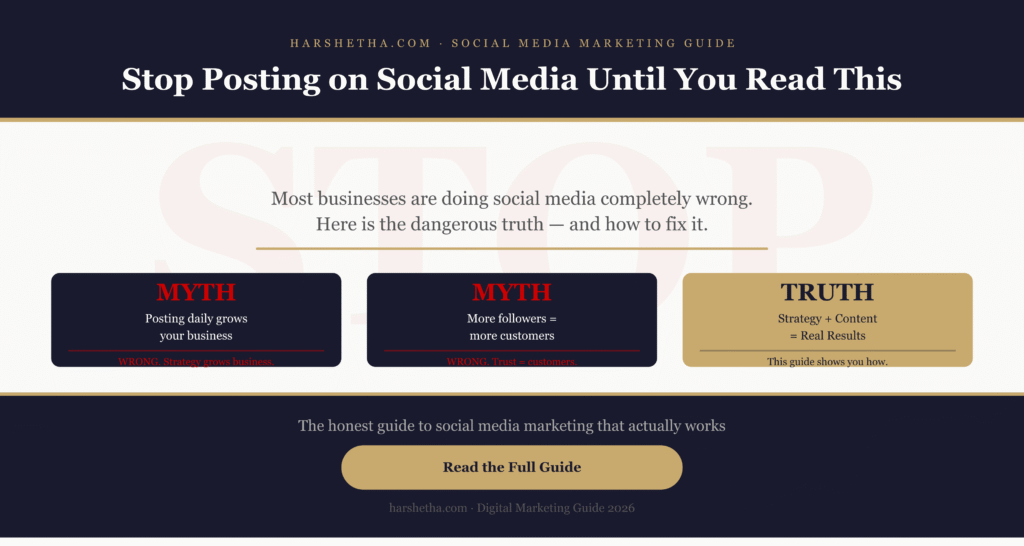
Quick Answer: Posting on social media without a clear strategy is one of the biggest mistakes businesses make online. Most brands post consistently but see zero leads or sales because they are focused on being active rather than being strategic. This guide breaks down exactly why random posting fails, what a real social media marketing strategy looks like, and how to turn your social media presence into an actual business growth tool.
Contents
- 1 The Hard Truth Nobody in Digital Marketing Wants to Say
- 2 Why Most Businesses Are Wasting Time on Social Media
- 3 The 3 Questions You Must Answer Before Posting Anything
- 4 What a Real Social Media Marketing Strategy Actually Looks Like
- 5 The Content That Actually Drives Leads and Sales on Social Media
- 6 The Biggest Social Media Mistakes Businesses Make — And How to Fix Them
- 7 How to Build a Social Media Strategy That Actually Works — In 5 Steps
- 8 When to Add Paid Ads to Your Social Media Strategy
- 9 Final Thoughts — Strategy First. Always.
- 10 Frequently Asked Questions
The Hard Truth Nobody in Digital Marketing Wants to Say
You wake up. You post. You wait.
A few likes. Maybe a comment. And then — nothing.
No leads. No enquiries. No sales. Just a number going up on a screen that means absolutely nothing for your business.
Sound familiar?
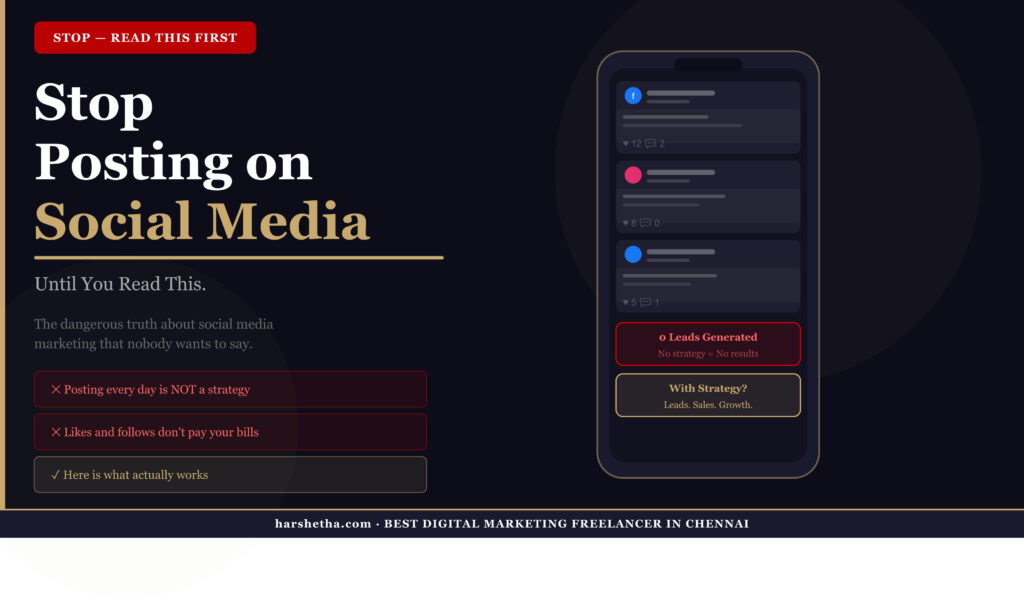
Here is the hard truth nobody in digital marketing wants to say out loud — posting on social media without a strategy is not marketing. It is just noise.
Most businesses are so focused on showing up consistently that they completely forget to ask the most important question — why am I posting this and what do I want it to do for my business?
Posting every day without a clear social media marketing strategy is like running on a treadmill. Lots of effort. Zero distance covered.
Before you schedule your next post — read this. Because what you are about to learn might completely change how you think about social media forever.
Why Most Businesses Are Wasting Time on Social Media
Let’s start with some numbers. According to HubSpot’s 2024 Marketing Report, 63% of businesses say their social media efforts produce little to no measurable business results. More than half of all the time and money spent on social media is producing nothing.
And according to Sprout Social, the average organic reach of a Facebook post is now less than 5% — meaning if you have 1000 followers, fewer than 50 people see what you post. On Instagram, organic reach has been declining year after year.
So why do businesses keep posting? Because busyness feels like progress. Because posting every day feels productive. Because everyone else is doing it so it must be working — right?
Wrong.
The problem is not social media itself. Social media marketing works incredibly well when done with intention and strategy. The problem is the random, reactive, post-and-pray approach that most businesses use — and then wonder why nothing is happening.
The 5 Signs Your Social Media is Not Working
- You post regularly but your follower count barely moves
- You get likes from friends and family but never from potential customers
- Nobody ever reaches out to you through social media about your services
- You have no idea which posts are performing well or why
- Your social media looks active but your business feels invisible
If any of these sound familiar — you do not have a social media problem. You have a social media strategy problem. And that is actually good news. Because strategy is something you can fix.
The 3 Questions You Must Answer Before Posting Anything
Every single post you put on social media should be able to answer three questions. If it cannot — do not post it. This one rule alone will transform your social media marketing strategy.
Question 1 — Who is this for?
Not everyone. Not your followers. Not people who might be interested. Be specific. Who is the exact person this post is speaking to? A 35-year-old business owner in Chennai trying to get more leads online? A young entrepreneur just starting out? A restaurant owner trying to fill tables on weekdays?
The more specific you are about who you are talking to — the more that person will feel like you are speaking directly to them. And the more they feel that — the more likely they are to engage, follow, and eventually buy.
Question 2 — What do I want them to do after seeing this?
Every post needs a purpose. Not every post needs to sell — but every post should move someone one step closer to trusting you, remembering you, or taking action.
Do you want them to save the post? Share it? Click the link in your bio? Send you a DM? Comment their answer? Visit your website?
A post without a clear purpose is just content for content’s sake. Social media marketing only works when every piece of content has an intention behind it.
Question 3 — Does this build my brand or just fill my feed?
There is a difference between content that builds your reputation and content that just keeps your account active. Reposting quotes, sharing memes, and posting random photos might keep your feed looking busy — but none of it builds the trust, authority, or desire that converts followers into customers.
Ask yourself — if someone visited my profile right now for the first time, would they immediately understand what I do, who I help, and why they should work with me? If the answer is no — your content strategy needs work.
What a Real Social Media Marketing Strategy Actually Looks Like
A real social media marketing strategy is not complicated. But it is intentional. Here is what it covers:
1. A Clear Goal
What do you actually want social media to do for your business? Brand awareness? Lead generation? Website traffic? Direct sales? Community building?
Pick one primary goal. Not five. Not two. One. Everything you post should serve that goal in some way. Without a clear goal, you are just posting into the void.
2. A Defined Audience
Who are you trying to reach? Write down the profile of your ideal customer — their age, their job, their problems, their goals, their fears, and what they search for online.
The more clearly you understand your audience, the more your social media content will resonate with them. Content that speaks to everyone speaks to no one.
3. A Content Mix That Serves Your Audience
According to Buffer’s research, the most effective social media content mix follows the 80-20 rule — 80% of your content should educate, entertain, or inspire your audience, and 20% should directly promote your product or service.
Here is a simple content mix that works for most businesses:
- Educational posts — tips, guides, how-tos that help your audience solve a problem
- Behind the scenes — show your process, your workspace, your work in progress
- Social proof — client results, testimonials, case studies
- Personal posts — your story, your opinions, your journey — builds connection
- Promotional posts — your services, your offers, your CTA — maximum 20%
4. Consistency Over Volume
You do not need to post every day. You need to post consistently. Three strong, intentional posts per week will always outperform seven rushed, random posts.
According to Hootsuite’s 2026 Social Media Trends report, quality and relevance of content matter significantly more than posting frequency for driving meaningful engagement and business results.
5. Engagement Before Broadcasting
Social media is a two-way conversation — not a billboard. The businesses that grow fastest on social media spend as much time engaging with other people’s content as they do posting their own.
Comment on posts in your niche. Reply to every comment on your own posts. Answer DMs promptly. Ask questions. Start conversations. The algorithm rewards accounts that create genuine interaction — and so do potential customers.
The Content That Actually Drives Leads and Sales on Social Media
Not all content is equal. Some types of social media content consistently outperform others when it comes to generating real business results. Here is what actually works:
Problem-Solution Content
Identify the biggest problem your ideal customer faces and create content that addresses it directly. This type of content gets saved, shared, and remembered — because it is genuinely useful.
Example: If you are a digital marketing freelancer — a post about why businesses are invisible on Google and what to do about it will perform far better than a post about what you had for lunch.
Social Proof Content
Results speak louder than anything you can say about yourself. Share client wins — even small ones. A screenshot of a positive message. A before and after. A metric that improved. Real proof that you deliver results builds more trust than any amount of self-promotion.
Opinion and Perspective Content
Bold opinions get attention. If everyone in your industry says one thing and you have a well-reasoned different perspective — share it. This type of content positions you as a thought leader and attracts people who share your values and approach.
Educational Content That Showcases Your Expertise
Teaching what you know for free is one of the most powerful social media marketing strategies available. Every tip you share, every guide you post, every question you answer publicly — demonstrates your expertise to potential clients who are watching.
People buy from people they trust. And trust is built by consistently showing up and providing value before asking for anything in return.
Story Content
Stories — your journey, your failures, your lessons, your wins — create emotional connection. And emotional connection drives purchasing decisions more than any feature list or price point ever will.
Share the real story behind your business. People do not just buy products and services — they buy from people they feel connected to.
The Biggest Social Media Mistakes Businesses Make — And How to Fix Them
Mistake 1 — Treating All Platforms the Same
Instagram is visual. LinkedIn is professional. Facebook is community-driven. Twitter is conversational. TikTok is entertaining. Each platform has its own culture, its own algorithm, and its own type of content that performs best.
Copying the same post across all platforms without adapting it is one of the most common social media mistakes. What works on Instagram often falls flat on LinkedIn. What performs on Facebook may not resonate on Instagram Reels.
Pick the one or two platforms where your ideal customers spend the most time and focus there. Do fewer platforms better rather than all platforms badly.
Mistake 2 — Focusing on Followers Instead of Leads
Followers are not customers. A page with 50,000 followers that generates zero leads is worth less to your business than a page with 500 followers that generates 10 enquiries per month. Stop chasing vanity metrics and start measuring what actually matters — website clicks, DM enquiries, form submissions, and sales.
Mistake 3 — No Call to Action
Every post needs to tell people what to do next. Not aggressively — but clearly. Save this post. Share this with someone who needs it. Click the link in bio. Send me a DM. Comment below.
People will not take action unless you invite them to. A post without a call to action is a missed opportunity every single time.
Mistake 4 — Giving Up Too Soon
Building a social media presence that generates business takes time. Most businesses give up after 60 to 90 days because they do not see immediate results. But the businesses that commit for 6 to 12 months — with a real strategy — see compounding results that paid advertising simply cannot replicate.
Consistency over time is the most underrated strategy in social media marketing.
Mistake 5 — No Strategy Behind the Content
This is the root cause of every other mistake on this list. Without a social media marketing strategy — a clear goal, a defined audience, a content plan, and measurable metrics — everything else is guesswork.
Strategy is not complicated. But it does require you to sit down, think clearly about what you want, and make intentional decisions about every piece of content you put out.
How to Build a Social Media Strategy That Actually Works — In 5 Steps
Step 1 — Define Your One Goal
What is the single most important thing you want social media to do for your business right now? Choose one. Write it down. Every decision you make about your social media content from this point forward should serve that goal.
Step 2 — Know Your Audience Deeply
Write a detailed profile of your ideal customer. Their age, their location, their job, their daily struggles, their goals, their fears, and the questions they type into Google at 11pm when they cannot sleep. The better you know them — the better your content will speak to them.
Step 3 — Choose Your Platform
Pick one or two platforms where your ideal customer is most active. For most businesses in India — Instagram and Facebook are where the majority of potential customers spend their time. Focus there first before expanding to other platforms.
Step 4 — Build Your Content Pillars
Content pillars are the 3 to 5 core topics you will consistently post about. They should all be relevant to your audience and connected to your business. For a digital marketing freelancer — content pillars might be SEO tips, social media strategy, business growth advice, client results, and behind the scenes content.
Having content pillars means you never stare at a blank screen wondering what to post. You always have a framework to work within.
Step 5 — Measure What Matters
Set up a simple tracking system. Every week look at which posts got the most saves, shares, profile visits, and link clicks — not just likes. These metrics tell you what your audience actually found valuable. Do more of what works. Stop doing what does not.
If all of this sounds like a lot to manage on top of running your business — it is. That is exactly why working with a digital marketing professional makes sense. Harshetha at harshetha.com helps businesses build and execute social media strategies that actually generate leads — not just engagement.
When to Add Paid Ads to Your Social Media Strategy
Organic social media marketing builds long-term brand equity. Paid ads accelerate results. The two work best together — but only when your organic strategy is already working.
Here is the rule: if your organic content is not resonating with your audience — paid ads will not fix it. They will just spend money amplifying content that is already not working.
Get your social media strategy right first. Build content that your audience genuinely responds to. Then use paid ads to put that content in front of more of the right people.
If you want to understand when and how to use paid ads alongside your organic strategy — read our complete guide to Meta Ads vs Google Ads where we break down exactly which platform is right for your business goals.
Final Thoughts — Strategy First. Always.
The businesses winning on social media in 2026 are not the ones posting the most. They are the ones posting with the most intention.
Every post has a purpose. Every piece of content serves their audience. Every caption has a clear call to action. And behind it all — there is a social media marketing strategy that connects everything together and moves the business forward.
Stop posting just to post. Stop chasing likes and follower counts. Stop measuring your social media success by how busy your feed looks.
Start asking — is this content moving my business forward? Is it reaching the right people? Is it building the trust and authority that eventually converts strangers into paying customers? That is the only question that matters in social media marketing.
And if you are ready to build a social media strategy that actually works for your business — reach out to Harshetha at harshetha.com. Because social media marketing done right is one of the most powerful tools available to any business. Done wrong — it is just a very time-consuming way to feel busy.
Your competitors are posting with strategy while you are posting with hope. Every day without a plan is another day they get ahead. Tired of Being on Page 5? → Link to: https://harshetha.com/contact-us-2
Frequently Asked Questions
1. Why is my social media not growing even though I post every day?
Posting frequency alone does not drive growth. What matters is the quality, relevance, and strategy behind your content. If your posts are not speaking directly to your ideal customer, addressing their specific problems, or giving them a clear reason to follow and engage — frequency will not help. Focus on creating content that genuinely serves your audience before worrying about how often you post.
2. How many times should I post on social media per week?
Quality always beats quantity. For most small businesses, 3 to 5 strong, intentional posts per week is more effective than posting every day without a clear strategy. Consistency matters more than volume — pick a schedule you can maintain without compromising the quality of your content.
3. Which social media platform is best for business in India in 2026?
For most businesses in India, Instagram and Facebook remain the strongest platforms for reaching and engaging potential customers. According to DataReportal, India has over 400 million active Instagram users and over 350 million Facebook users. LinkedIn is best for B2B businesses. YouTube is powerful for long-form educational content. Start with the platform where your ideal customers spend the most time.
4. What type of social media content gets the most engagement?
Content that educates, entertains, or emotionally connects performs best. Specifically — problem-solution posts, behind-the-scenes content, client success stories, bold opinions, and personal stories consistently drive higher engagement than promotional content. The 80-20 rule applies — 80% value, 20% promotion.
5. How do I turn social media followers into paying customers?
The key is building trust over time through consistent, valuable content — and then making it easy for followers to take the next step. Include clear calls to action in your posts. Make your contact information and services easy to find. Use link in bio tools to direct traffic to your website or contact page. And follow up promptly with anyone who reaches out through social media.
6. What is a social media content strategy?
A social media content strategy is a clear plan that defines your goals, your target audience, your content pillars, your posting schedule, and the metrics you will use to measure success. It is the difference between posting with purpose and posting with hope. A good strategy answers — why are we posting this, who is it for, and what do we want it to achieve.
7. Should I focus on organic social media or paid ads?
Ideally both — but in the right order. Build your organic social media strategy first. Create content that resonates with your audience and builds genuine trust. Then use paid ads to amplify what is already working and reach new audiences. Paid ads on a weak organic foundation rarely deliver strong results.
8. How long does it take to see results from social media marketing?
With a clear strategy and consistent execution, most businesses start seeing meaningful engagement improvements within 30 to 60 days. Lead generation from social media typically takes 3 to 6 months of consistent effort. Social media is a long-term investment — the businesses that commit for 6 to 12 months see compounding results that are very difficult for competitors to replicate.
9. What is the best time to post on social media in India?
Research suggests that for Indian audiences, the best times to post on Instagram and Facebook are between 7am to 9am, 12pm to 2pm, and 7pm to 10pm — when people are commuting, on lunch breaks, or unwinding in the evening. However the best approach is to check your own account’s analytics to see when your specific audience is most active and adjust accordingly.
10. Should I hire someone to manage my social media?
If social media is taking significant time away from running your business — or if it is not generating any measurable results despite your efforts — hiring a professional makes sense. A skilled social media manager or digital marketing freelancer will create a strategy, execute it consistently, and report results — freeing you to focus on what you do best.
11. Why do some businesses go viral while others do not?
Viral content typically triggers a strong emotional response — it makes people laugh, cry, feel inspired, or feel seen. It is usually simple, relatable, and easy to share. But viral posts are not a reliable strategy for most businesses. Instead of chasing virality, focus on creating content that consistently reaches and resonates with your specific target audience. Slow, steady growth from the right audience beats a viral moment that attracts the wrong one.
12. How do I know if my social media marketing is working?
Track the metrics that matter for your specific goal. For brand awareness — reach and impressions. For engagement — comments, saves, and shares. For lead generation — DM enquiries, link clicks, and website traffic from social media. For sales — direct conversions attributed to social media. Set a baseline in month one and track progress monthly.
13. What is the difference between social media marketing and social media management?
Social media management is the operational side — scheduling posts, responding to comments, managing the day-to-day of your social accounts. Social media marketing is the strategic side — developing the strategy, creating content designed to achieve specific business goals, running paid campaigns, and measuring ROI. The best results come when both are done well and aligned with each other.
14. How important is video content for social media in 2026?
Extremely important. Video content — particularly short-form video like Instagram Reels and Facebook Reels — consistently gets the highest organic reach of any content format on social media in 2026. According to Hootsuite, video posts generate 48% more engagement than other content types. If you are not already creating short-form video content — it should be the next thing you add to your social media strategy.
15. What are content pillars and why do I need them?
Content pillars are the 3 to 5 core topics you consistently create content about. They keep your social media presence focused and relevant, make it easier to plan content in advance, and help your audience know what to expect from you. Without content pillars, your social media becomes scattered and unfocused — making it hard for anyone to understand what you stand for and who you serve.
16. How do hashtags work and should I still use them?
Hashtags help categorize your content and make it discoverable to people who do not already follow you. In 2026, fewer targeted hashtags work better than many random ones — 5 to 10 highly relevant hashtags typically outperform 30 generic ones. On Instagram, hashtags still help with discoverability. On Facebook, their impact is more limited. Research which hashtags your target audience actually follows and use those.
17. Should I post the same content on Instagram and Facebook?
Not exactly. While the core message can be the same, the format and tone should be adapted for each platform. Instagram is more visual and aesthetic — captions can be shorter and more visual. Facebook allows for longer form content and works well for community building and sharing articles. Adapt your content for the culture of each platform rather than copying and pasting the same post.
18. How do I get more people to see my posts without paying for ads?
Post consistently and at optimal times. Use relevant hashtags. Create content that encourages saves and shares — not just likes. Engage actively with other accounts in your niche. Reply to every comment on your posts. Collaborate with other creators or businesses. Use all available content formats — particularly Reels which get the highest organic reach on Instagram and Facebook in 2026.
19. What should I post on social media if I have no ideas?
Start with your audience’s questions. What do your customers ask you most often? Answer those questions in your posts. Share a tip from your area of expertise. Show behind the scenes of your work. Share a client result or testimonial. Post your opinion on a trend or news in your industry. Repurpose content from your blog or website into social media posts. Your content pillars should always give you a framework to work within when inspiration runs low.
20. How can a digital marketing freelancer help with my social media?
A digital marketing freelancer can help you build a clear social media strategy, create a content calendar, develop your brand voice, produce high-quality content, manage your accounts, run paid social campaigns, and track results — all while you focus on running your business. Harshetha at harshetha.com offers complete digital marketing services including social media strategy for businesses across India.
Meta Ads vs Google Ads → https://harshetha.com/meta-ads-vs-google-ads