
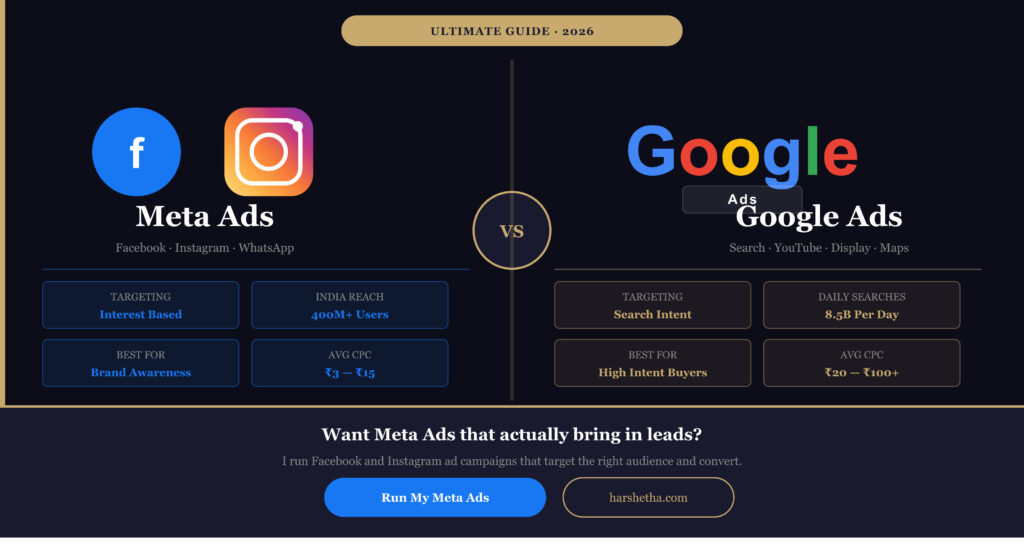
Quick Answer: Meta Ads vs Google Ads — which is better for your business? Meta Ads run on Facebook and Instagram and target people based on their interests and behaviours. Google Ads target people who are actively searching for what you offer. Meta Ads are best for brand awareness and reaching new audiences. Google Ads are best for capturing high-intent buyers. Most successful businesses use both together. This guide breaks down exactly which one — or which combination — is right for your specific goals and budget.
Contents
- 1 The Question Every Business Owner Asks
- 2 What Are Meta Ads?
- 3 What Are Google Ads?
- 4 Meta Ads vs Google Ads — The Key Differences
- 5 How Targeting Works — Meta Ads vs Google Ads
- 6 Cost Comparison — Meta Ads vs Google Ads
- 7 Meta Ads vs Google Ads — Which is Better for Your Business?
- 8 Which Platform Works Best for Each Industry?
- 9 Common Mistakes Businesses Make With Meta Ads and Google Ads
- 10 How to Get Started With Meta Ads and Google Ads
- 11 Final Verdict — Meta Ads vs Google Ads in 2026
- 12 Frequently Asked Questions — Meta Ads vs Google Ads
The Question Every Business Owner Asks
If you have ever thought about running paid ads for your business, you have almost certainly faced the Meta Ads vs Google Ads question. Both platforms are powerful. Both can drive real results. But they work very differently — and choosing the wrong one for your goals can waste a significant amount of money.
In this complete Meta Ads vs Google Ads comparison, I break down exactly how each platform works, what it costs, who it is best for, and which one — or which combination — makes the most sense for your business in 2026.
Whether you are a small business owner just getting started with paid advertising or an established brand looking to scale, understanding the difference between Meta Ads and Google Ads is one of the most important decisions you will make for your marketing budget.
And if you are still building your organic presence alongside paid advertising, I recommend reading our complete guide to SEO first — because the best digital marketing strategies always combine both paid and organic channels.
What Are Meta Ads?
Meta Ads are paid advertisements that run across Meta’s family of platforms — Facebook, Instagram, WhatsApp, and Messenger. When you see a sponsored post in your Instagram feed, a video ad on Facebook, or a promoted story — that is a Meta Ad.
Meta’s advertising platform is one of the most powerful targeting tools ever built. It uses the enormous amount of data Meta collects about its users — their interests, behaviours, demographics, and online activity — to help advertisers reach incredibly specific audiences. According to DataReportal, Meta’s platforms reach over 400 million users in India alone.
The key thing to understand about Meta Ads is that they are interruption-based. You are putting your ad in front of people who were not necessarily looking for your product. They were scrolling through their feed — and your ad stopped them. This means your creative — the image, video, and copy — has to be strong enough to grab attention in the first two seconds.
Types of Meta Ads
- Image Ads — single image with text and a call to action button
- Video Ads — short or long form video content in feed or stories
- Carousel Ads — multiple images or videos in one swipeable ad
- Story Ads — full screen vertical ads that appear between stories
- Reels Ads — short video ads that appear between Instagram and Facebook Reels
- Collection Ads — product catalog ads for e-commerce businesses
- Lead Generation Ads — forms that collect contact details without leaving the platform
What Are Google Ads?
Google Ads are paid advertisements that appear on Google’s search results pages, YouTube, Gmail, and the Google Display Network. When you search for something on Google and see results marked as ‘Sponsored’ at the top — those are Google Ads.
Unlike Meta Ads, Google Ads are intent-based. You are targeting people who are actively searching for what you offer right now. They typed a specific query into Google — which means they already have a need. Your ad appears at the exact moment that need is expressed. According to WordStream, Google processes over 8.5 billion searches every single day.
This is what makes Google Ads so powerful for businesses with products or services that people actively search for. The purchase intent is already there — your ad just needs to be the most compelling answer to their search.
Types of Google Ads
- Search Ads — text ads that appear at the top of Google search results
- Display Ads — image and banner ads across millions of websites in Google’s network
- Shopping Ads — product listings with images and prices for e-commerce
- Video Ads — ads that appear before, during, or after YouTube videos
- Performance Max — AI-powered campaigns that run across all Google channels
- Local Ads — ads that promote your physical business location on Google Maps
Meta Ads vs Google Ads — The Key Differences
| Feature | Meta Ads | Google Ads |
| Intent | Interruption based | Search intent based |
| Platform | Facebook & Instagram | Google Search & YouTube |
| Targeting | Interest & behaviour | Keywords & search queries |
| Best For | Brand awareness & reach | High intent buyers |
| Ad Format | Visual — image & video | Text, image & video |
| Average CPC | Rs 3 to Rs 15 | Rs 20 to Rs 100+ |
| Learning Curve | Moderate | Steeper |
| Results Speed | Fast — days | Fast — days |
| Long Term Value | Good | Very Good |
| Best Industry | Fashion, lifestyle, food | Services, B2B, local |
How Targeting Works — Meta Ads vs Google Ads
Meta Ads Targeting
Meta’s targeting is based on who people are — their demographics, interests, and behaviours. You can target people based on:
- Age, gender, and location — down to a specific city or radius
- Interests — people interested in fitness, fashion, food, real estate, and thousands of other categories
- Behaviours — people who shop online frequently, recently moved, or have specific purchasing habits
- Custom Audiences — upload your own customer list and target them directly on Meta
- Lookalike Audiences — find new people who share characteristics with your best existing customers
- Retargeting — show ads to people who visited your website or engaged with your content
This makes Meta Ads incredibly powerful for reaching people who do not know they need your product yet — but who fit the profile of someone who would love it.
Google Ads Targeting
Google’s targeting is based on what people are doing — specifically what they are searching for right now. You target keywords — the exact words and phrases people type into Google. You can also target based on:
- Keywords — specific search terms your ideal customer uses
- Location — target people searching in specific cities or regions
- Device — desktop, mobile, or tablet
- Time of day — show ads during your business hours only
- Audience lists — retarget past website visitors or customer lists
- In-market audiences — people Google has identified as actively researching a purchase
The advantage of Google Ads targeting is that it captures people at the exact moment of purchase intent. When someone searches ‘digital marketing freelancer in Chennai’ — they are looking to hire someone right now. That is the perfect moment to show them your ad.
Cost Comparison — Meta Ads vs Google Ads
One of the most common questions in the Meta Ads vs Google Ads debate is: which one is cheaper?
Meta Ads Cost
Meta Ads are generally more affordable than Google Ads. The average cost per click (CPC) for Meta Ads in India ranges from Rs 3 to Rs 15 depending on your industry and audience. The average CPM (cost per 1000 impressions) ranges from Rs 80 to Rs 200 — meaning you can reach 1000 people for less than the cost of a cup of coffee.
Meta Ads tend to be cheaper because you are reaching people who were not actively looking for your product — so the competition is lower than Google Search where multiple businesses are bidding for the same high-intent keywords.
Google Ads Cost
Google Ads can be significantly more expensive — especially for competitive industries. The average CPC for Google Search Ads in India ranges from Rs 20 to Rs 100+ depending on the keyword and industry. Competitive industries like real estate, finance, legal, and education can see CPCs of Rs 200 to Rs 500 or more.
However the higher cost often reflects higher purchase intent. Someone clicking a Google Ad for ‘best digital marketing freelancer in Chennai’ is much more likely to convert into a paying client than someone who saw your Meta Ad while scrolling through Instagram.
Which is More Cost Effective?
According to HubSpot’s 2024 marketing report, the average return on ad spend (ROAS) for Meta Ads is 3x to 5x while Google Ads average 4x to 8x for well-managed campaigns. But this depends entirely on your industry, your targeting, and how well your campaigns are set up.
For most small businesses in India, Meta Ads offer a lower barrier to entry — you can start seeing results with Rs 5,000 to Rs 10,000 per month. Google Ads typically need Rs 10,000 to Rs 20,000 minimum to gather meaningful data.
Meta Ads vs Google Ads — Which is Better for Your Business?
The honest answer is that neither Meta Ads nor Google Ads is universally better. The right choice depends on your specific business, goals, and audience. Here is a simple guide:
Choose Meta Ads if:
- You sell visual products — fashion, food, lifestyle, beauty, home decor
- You want to build brand awareness and reach new audiences
- Your target audience spends a lot of time on Facebook or Instagram
- You have strong visual content — great photos or videos
- You want to reach people before they know they need your product
- You are an e-commerce business wanting to showcase your product catalog
- You have a smaller budget and want maximum reach
Choose Google Ads if:
- You offer a service people actively search for — plumber, lawyer, doctor, freelancer
- You want to capture high-intent buyers who are ready to purchase now
- You are in a competitive local market and want to appear first in searches
- You run an e-commerce store and want to appear in Google Shopping results
- You want to target people based on specific keywords they are searching
- Your business relies on local customers finding you online
Use Both if:
According to Google’s own research, businesses that run both Search and Social ads see 35% higher conversion rates than those using a single channel. The best Meta Ads vs Google Ads strategy is not choosing one — it is using both together strategically:
- Use Google Ads to capture people actively searching for your product or service
- Use Meta Ads to retarget website visitors who did not convert
- Use Meta Ads for awareness — Google Ads for conversion
- Use Meta Ads to build your audience — Google Ads to close the sale
Which Platform Works Best for Each Industry?
Meta Ads Works Best For:
- Fashion and clothing brands — highly visual, emotional purchase decisions
- Restaurants and food delivery — reach local hungry audiences
- Beauty and skincare — visual transformation content performs extremely well
- Fitness and wellness — aspirational content drives strong engagement
- Real estate — reach people by location and life stage
- Education and coaching — build audiences with interest-based targeting
- E-commerce stores — product catalog ads drive strong direct sales
Google Ads Works Best For:
- Local service businesses — plumbers, electricians, lawyers, doctors
- Digital marketing freelancers — people searching for specific expertise
- B2B services — businesses searching for solutions to specific problems
- Healthcare — clinics and hospitals capturing patients searching for care
- Home services — renovation, interior design, moving companies
- Financial services — insurance, loans, investment products
- Software and SaaS — targeting businesses searching for specific tools
Common Mistakes Businesses Make With Meta Ads and Google Ads
Meta Ads Mistakes
- Targeting too broad an audience — wasting budget on people who will never buy
- Using weak creative — boring images or videos that do not stop the scroll
- No clear call to action — people do not know what to do next
- Not testing different ad variations — always A/B test your creatives
- Boosting posts instead of running proper campaigns — boosting wastes money
- Ignoring the data — Meta gives you rich analytics that most people never read
Google Ads Mistakes
- Targeting too broad keywords — spending money on irrelevant searches
- Not using negative keywords — paying for clicks that will never convert
- Sending traffic to a poor landing page — great ads need great destinations
- Not tracking conversions — you cannot optimize what you cannot measure
- Setting and forgetting — Google Ads needs constant monitoring and adjustment
- Ignoring Quality Score — a low quality score means higher costs and lower rankings
How to Get Started With Meta Ads and Google Ads
Getting Started With Meta Ads
- Create a Meta Business Manager account at business.facebook.com
- Connect your Facebook Page and Instagram account
- Set up your Meta Pixel on your website to track visitors
- Define your objective — awareness, traffic, leads, or conversions
- Build your audience — start with interest-based targeting
- Create your ad creative — strong image or video with clear copy
- Set your budget — start with Rs 5,000 to Rs 10,000 to test
- Launch and monitor daily for the first week
Getting Started With Google Ads
- Create a Google Ads account at ads.google.com
- Set up Google Analytics and conversion tracking on your website
- Do thorough keyword research — find what your customers are searching
- Create tightly themed ad groups — one theme per ad group
- Write compelling ad copy with your keyword in the headline
- Build a dedicated landing page for your ads
- Set your budget — start with Rs 10,000 to Rs 15,000 to gather data
- Monitor your search terms report daily and add negative keywords
If all of this feels overwhelming — that is completely normal. Both platforms have steep learning curves. Working with an experienced professional like Harshetha at harshetha.com can save you significant time and money by avoiding the costly mistakes most businesses make when they first start running ads.
Final Verdict — Meta Ads vs Google Ads in 2026
The Meta Ads vs Google Ads debate does not have one single winner. Both platforms are powerful. Both can deliver exceptional results. The right answer depends entirely on your business, your audience, and your goals.
Choose Meta Ads if you want to build brand awareness, reach new audiences with visual content, or sell products to people before they start searching.
Choose Google Ads if you want to capture high-intent buyers who are actively searching for what you offer right now.
Use both if you want to build a complete paid advertising system that works at every stage of the customer journey — from awareness all the way through to purchase.
Whatever you decide — start with a clear goal, a realistic budget, and a willingness to test and learn. Paid advertising rewards patience and data-driven decision making. If you need expert help setting up and managing your Meta Ads or Google Ads campaigns, reach out to Harshetha at harshetha.com — a certified digital marketing freelancer in Chennai specializing in paid advertising, SEO, and web development.
Still not sure which platform is right for you? Tired of Being on Page 5? Let’s figure it out together.
Frequently Asked Questions — Meta Ads vs Google Ads
1. What is the main difference between Meta Ads and Google Ads?
Meta Ads target people based on who they are — their interests, demographics, and behaviours on Facebook and Instagram. Google Ads target people based on what they are actively searching for on Google. Meta Ads interrupt people while scrolling. Google Ads appear when people are actively looking for what you offer.
2. Which is cheaper — Meta Ads or Google Ads?
Meta Ads are generally cheaper. The average CPC for Meta Ads in India is Rs 3 to Rs 15 compared to Rs 20 to Rs 100+ for Google Search Ads. However cheaper does not always mean better value — Google Ads often deliver higher purchase intent which can result in better conversion rates despite the higher cost per click.
3. Which platform gives better ROI — Meta Ads or Google Ads?
It depends on your industry and how well your campaigns are managed. Google Ads typically deliver higher ROI for service businesses where purchase intent is high. Meta Ads deliver stronger ROI for e-commerce, visual products, and brand awareness campaigns. Well-managed campaigns on either platform can deliver ROAS of 3x to 8x or higher.
4. Can I run Meta Ads and Google Ads at the same time?
Absolutely — and this is actually the recommended approach. Businesses that run both platforms see 35% higher conversion rates than those using a single channel. Use Google Ads to capture high-intent searchers and Meta Ads to retarget website visitors and build brand awareness with new audiences.
5. How much should I spend on Meta Ads per month?
Start with Rs 5,000 to Rs 10,000 per month to test and gather meaningful data. For scalable results, most experienced digital marketing professionals recommend Rs 15,000 to Rs 30,000 per month in ad spend. This is your budget paid directly to Meta — separate from any management fees.
6. How much should I spend on Google Ads per month?
Google Ads typically need a minimum of Rs 10,000 to Rs 15,000 per month to gather enough data to optimize effectively. For competitive industries or local service businesses, Rs 20,000 to Rs 50,000 per month is more realistic for meaningful results.
7. Which platform is better for local businesses?
Google Ads — specifically Google Local Ads and Google Maps advertising — are generally more effective for local service businesses because they capture people actively searching for services in your area. Meta Ads work well for local businesses too — particularly for building awareness and retargeting local website visitors.
8. Are Meta Ads good for B2B businesses?
Meta Ads can work for B2B but LinkedIn Ads or Google Ads are often more effective for reaching business decision-makers. That said, Meta’s interest-based targeting can be powerful for B2B businesses targeting specific industries or job functions — particularly for content promotion and lead generation campaigns.
9. Which platform is better for e-commerce?
Both work well for e-commerce. Meta Ads — particularly Instagram Shopping and Facebook Catalog ads — are excellent for visual product discovery and impulse purchases. Google Shopping Ads capture high-intent buyers who are actively searching for specific products. The best e-commerce strategy uses both together.
10. How long does it take to see results from Meta Ads?
Most Meta Ads campaigns start delivering results within 3 to 7 days of launch. The platform needs time to learn which audiences respond best to your ads — this is called the learning phase and typically takes 50 optimization events. Expect to wait 2 to 4 weeks before making major campaign decisions.
11. How long does it take to see results from Google Ads?
Google Search Ads can deliver results within hours of launching — as soon as someone searches your target keyword and clicks your ad. However, it takes 2 to 4 weeks of data to properly optimize bids, keywords, and ad copy for maximum efficiency and return on ad spend.
12. What is a good click-through rate for Meta Ads?
The average click-through rate for Meta Ads across all industries is around 0.9% to 1.5%. A rate above 2% is considered strong. Your CTR depends heavily on your creative quality, audience relevance, and how well your ad copy matches what your audience cares about.
13. What is retargeting and should I use it?
Retargeting means showing ads to people who have already visited your website or interacted with your brand. These people are already familiar with you — so conversion rates are much higher than cold audience campaigns. Both Meta Ads and Google Ads support retargeting and it should be part of every paid advertising strategy.
14. Do I need a website to run Meta Ads or Google Ads?
For Google Ads — yes, you need a website with a dedicated landing page to send traffic to. For Meta Ads — not necessarily. You can run Lead Generation campaigns that collect contact details directly within Facebook or Instagram without the person ever visiting your website. However a well-optimized website always improves results on both platforms.
15. What is a Meta Pixel and do I need it?
The Meta Pixel is a piece of code you add to your website that tracks visitor activity and sends data back to Meta. It is essential for running effective Meta Ads because it enables conversion tracking, retargeting, and audience optimization. Install it on your website before you start running any Meta Ads campaigns.
16. What is Quality Score in Google Ads and why does it matter?
Quality Score is Google’s rating of the relevance and quality of your keywords, ads, and landing pages. It directly affects how much you pay per click and where your ads appear. A higher Quality Score means lower costs and better ad positions. Improving your Quality Score is one of the most impactful ways to get more value from your Google Ads budget.
17. Can a small business afford to run Google Ads?
Yes — but it requires careful keyword selection and campaign management. Small businesses should focus on specific long-tail keywords with lower competition, use tight geo-targeting to reduce waste, and set strict daily budgets to control spending. Starting with a small test budget of Rs 10,000 to Rs 15,000 per month is the smart approach.
18. Which platform has better analytics — Meta Ads or Google Ads?
Both platforms offer excellent analytics. Meta Ads Manager provides detailed data on reach, impressions, clicks, conversions, and audience demographics. Google Ads provides search term reports, Quality Scores, conversion tracking, and integration with Google Analytics. Most digital marketing professionals use both sets of data together for the full picture.
19. Should I hire someone to manage my Meta Ads and Google Ads?
For most businesses — yes. Both platforms have significant learning curves and the cost of mistakes can be high. An experienced digital marketing professional typically pays for themselves many times over by reducing wasted ad spend and improving campaign performance. If you want expert help with your paid advertising strategy, Harshetha at harshetha.com specializes in Meta Ads and full-service digital marketing for businesses across India.
20. What is the best way to start with paid advertising if I have never done it before?
Start with one platform — not both at once. If you sell a visual product or want brand awareness, start with Meta Ads. If you offer a service people actively search for, start with Google Ads. Set a small test budget, define one clear objective, create strong creative or ad copy, and track everything from day one. Give your campaign at least 30 days before making major changes. And if you are unsure where to start — reach out to a digital marketing professional who can guide you based on your specific business and goals.
Your competitors are already running ads. Every day you wait is another customer they are getting instead of you. Tired of Being on Page 5? → Link to: https://harshetha.com/contact-us-2