
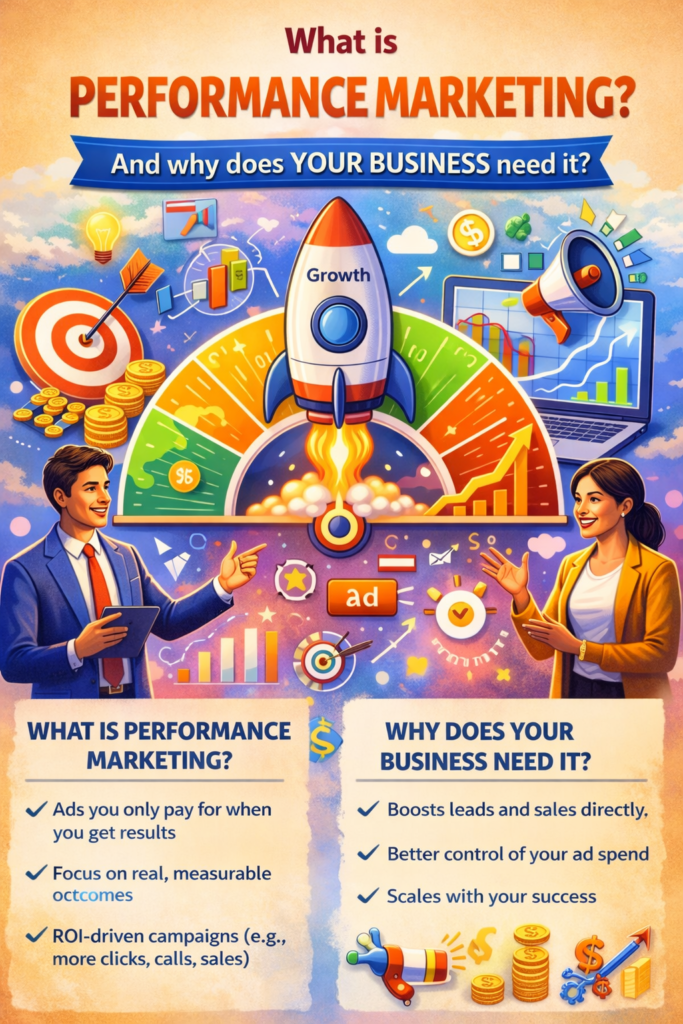
Quick Answer: What is performance marketing? Performance marketing is a results-driven form of digital advertising where you only pay when a specific action is completed — like a click, a lead, a sale, or an app install. Unlike traditional advertising where you pay upfront regardless of results, performance marketing ties every rupee you spend directly to a measurable outcome. It is one of the most cost-effective and accountable forms of marketing available to businesses of any size.
Contents
- 1 What is Performance Marketing — And Why Are Businesses Obsessed With It?
- 2 What is Performance Marketing? The Complete Definition
- 3 How Does Performance Marketing Work?
- 4 Types of Performance Marketing — The Complete Breakdown
- 5 Performance Marketing vs Traditional Marketing
- 6 Performance Marketing vs Brand Marketing
- 7 Why Your Business Needs Performance Marketing in 2026
- 8 How to Get Started With Performance Marketing
- 9 Performance Marketing in India — The Opportunity Right Now
- 10 Final Thoughts — Performance Marketing is the Future of Business Growth
- 11 Frequently Asked Questions About Performance Marketing
What is Performance Marketing — And Why Are Businesses Obsessed With It?
What is performance marketing? It is the question every business owner eventually asks — usually after spending money on traditional advertising and seeing very little to show for it.
Imagine paying for a newspaper ad. You spend the money. The ad runs. And then — you wait. You have no idea how many people saw it, how many were interested, or whether a single customer walked in because of it. You just paid and hoped.
Now imagine a completely different approach. You run a digital campaign and you only pay when someone actually clicks your ad, fills in your contact form, or makes a purchase. Every rupee you spend is tied to a real, measurable action. That is what performance marketing is — and that is why businesses across India and the world are shifting their budgets towards it.
According to Statista, India’s digital advertising market is projected to exceed Rs 40,000 crore by 2026. A significant and growing portion of that spend is performance-based. Businesses are no longer willing to pay for exposure alone — they want results. And performance marketing delivers exactly that.
This guide explains what performance marketing is, how it works, the different types available, how it compares to traditional and brand marketing, and how your business can use it to grow in 2026.
What is Performance Marketing? The Complete Definition
At its core, performance marketing is a form of digital marketing where advertisers pay only when a specific, pre-defined action is completed. This action could be a click, a lead, a form submission, a sale, an app download, or any other measurable outcome.
This is what makes performance marketing fundamentally different from traditional advertising. In traditional advertising — TV commercials, newspaper ads, billboards — you pay a fixed amount upfront regardless of whether anyone responds. In performance marketing you pay for performance. If the campaign does not perform, you do not pay.
The term what is performance marketing covers a broad range of channels and tactics. It includes paid search advertising like Google Ads, paid social advertising like Meta Ads, affiliate marketing, programmatic advertising, and influencer marketing with performance-based compensation. What they all have in common is measurability and accountability.
The Core Principle of Performance Marketing
The defining principle of performance marketing is simple: you pay for results, not reach.
Traditional marketing pays for the opportunity to be seen. Performance marketing pays for actions that have real business value. This shift in how advertising is bought and measured has fundamentally changed the economics of marketing for businesses of every size.
For small businesses in India with limited budgets, performance marketing is particularly powerful. Instead of spending Rs 50,000 on a newspaper ad that might reach 100,000 people but convert nobody, you can spend the same amount on Google Ads and only pay when someone who is actively searching for your product or service clicks through to your website.
How Does Performance Marketing Work?
Understanding what performance marketing is requires understanding how the payment model works. Here are the most common performance-based payment structures:
Cost Per Click (CPC)
You pay every time someone clicks your ad. This is the most common model in performance marketing and is used by Google Ads, Meta Ads, and most paid social platforms. You set a maximum amount you are willing to pay per click and the platform charges you only when someone actually clicks.
Cost Per Lead (CPL)
You pay every time someone completes a lead form — providing their name, email, or phone number. This model is popular for service businesses that need qualified enquiries rather than just website visits. Meta Ads Lead Generation campaigns and Google Ads conversion tracking both support CPL-based performance marketing.
Cost Per Acquisition (CPA)
You pay every time a specific conversion happens — a purchase, a booking, a subscription, or any other valuable action. CPA is the most result-oriented performance marketing model because you only pay when a real business outcome is achieved.
Cost Per Mille (CPM)
You pay per 1000 impressions — every time your ad is shown 1000 times. While this is closer to traditional advertising in structure, it is still part of performance marketing when combined with strong tracking and optimization because you can measure exactly what those impressions lead to.
Common in affiliate marketing, revenue share means you pay a percentage of every sale generated through a partner or affiliate. This is pure performance marketing — you only pay when revenue is actually generated.
Types of Performance Marketing — The Complete Breakdown
Performance marketing is not a single channel — it is an approach that spans multiple platforms and tactics. Here are the main types:
1. Paid Search Advertising — Google Ads
Google Ads is one of the most powerful performance marketing channels available. When someone searches for a keyword related to your business, your ad appears at the top of the results. You pay only when they click. Because the person is actively searching for what you offer, the purchase intent is extremely high — making Google Ads one of the highest-converting performance channels for service businesses.
2. Paid Social Advertising — Meta Ads
Meta Ads — Facebook and Instagram advertising — allow you to reach a precisely targeted audience based on demographics, interests, and behaviours. Unlike search ads that capture existing demand, Meta Ads create demand by reaching people who were not actively searching but match the profile of your ideal customer. Meta Ads are one of the most versatile performance marketing tools — useful for brand awareness, lead generation, e-commerce sales, and app installs.
For a detailed comparison of these two powerful performance marketing channels, read our complete guide to Meta Ads vs Google Ads.
3. Affiliate Marketing
Affiliate marketing is a pure performance marketing model where you pay partners — bloggers, influencers, comparison websites — only when they successfully refer a customer to your business. You set the commission and only pay when a real sale or lead is generated. For e-commerce businesses and online services, affiliate marketing can be one of the most cost-effective customer acquisition channels available.
4. Influencer Marketing with Performance Terms
Traditional influencer marketing pays a flat fee regardless of results. Performance-based influencer marketing ties compensation to specific outcomes — sales generated through a unique discount code, leads captured through a specific link, or app downloads tracked to a particular post. This hybrid model is growing rapidly in India as brands demand more accountability from influencer partnerships.
5. Programmatic Advertising
Programmatic advertising uses AI and automation to buy digital ad space in real time across thousands of websites and apps. It is highly targetable and measurable — making it a powerful performance marketing tool for businesses that want to reach their ideal audience at scale while maintaining tight control over their cost per acquisition.
6. Email Marketing with Performance Tracking
Email marketing becomes performance marketing when you track specific actions — open rates, click rates, conversions — and optimize your campaigns based on those metrics. A well-executed email marketing strategy can deliver one of the highest ROIs of any performance channel. According to HubSpot, email marketing delivers an average ROI of Rs 3,600 for every Rs 100 spent.
Performance Marketing vs Traditional Marketing
To fully understand what performance marketing is and why it matters — here is a direct comparison with traditional marketing:
| Feature | Performance Marketing | Traditional Marketing |
| Payment Model | Pay for results — clicks, leads, sales | Pay upfront regardless of results |
| Measurability | Fully measurable — every action tracked | Difficult to measure accurately |
| Budget Control | Set daily and campaign budgets precisely | Fixed costs with no flexibility |
| Targeting | Highly specific — demographics, interests, intent | Broad — reaches everyone including non-buyers |
| Speed | Launch and see results within hours | Slow — weeks to plan and execute |
| Optimization | Real-time optimization based on data | Limited — changes take weeks |
| ROI Transparency | Clear, measurable ROI for every campaign | ROI is estimated and often unclear |
| Best For | Lead generation, e-commerce, conversions | Brand awareness, large audiences |
| Minimum Budget | Can start with Rs 500 per day | Typically requires large upfront investment |
Performance Marketing vs Brand Marketing
Another common question when understanding what performance marketing is — how does it differ from brand marketing?
| Feature | Performance Marketing | Brand Marketing |
| Primary Goal | Generate leads, sales, conversions | Build awareness, trust, recognition |
| Timeline | Immediate results — days to weeks | Long-term — months to years |
| Measurement | Direct ROI — cost per lead, cost per sale | Brand recall, sentiment, share of voice |
| Payment | Pay per action or result | Pay for exposure and reach |
| Audience | High-intent buyers ready to act now | Broad audiences at all stages |
| Content Type | Direct response — clear CTA, offer | Storytelling, emotional connection |
| Risk | Low — only pay when it works | Higher — pay regardless of outcome |
| Best Use | Driving immediate revenue and leads | Building long-term brand equity |
The most effective businesses use both together. Performance marketing drives immediate revenue while brand marketing builds the trust and recognition that makes performance campaigns more effective over time.
Why Your Business Needs Performance Marketing in 2026
Now that you understand what performance marketing is — here is why your business specifically needs it right now:
1. Every Rupee is Accountable
In performance marketing, you know exactly what every rupee is doing. You can see your cost per click, cost per lead, and cost per sale in real time. This level of accountability is impossible with traditional advertising and makes budget decisions significantly easier and smarter.
2. You Only Pay for Real Results
The most powerful aspect of performance marketing is its payment model. You are not paying for the possibility of being seen. You are paying for actual business outcomes. This dramatically reduces wasted spend and improves the efficiency of your marketing budget.
3. You Can Start Small and Scale
Performance marketing does not require a large upfront investment. You can start a Google Ads campaign with Rs 500 per day. You can run a Meta Ads test with Rs 5,000. You can scale what works and stop what does not — in real time. This flexibility makes it ideal for small businesses and startups in India.
4. Your Competitors Are Already Using It
If your competitors are showing up on Google when your potential customers search for your service — they are using performance marketing. If they are running ads on Instagram and Facebook targeting your ideal audience — that is performance marketing. Every day you are not using these channels is a day your competitors are acquiring the customers you should be getting.
5. The Data Makes You Smarter Over Time
Every performance marketing campaign generates valuable data about your audience — what they respond to, what they ignore, what converts them and what does not. This data compounds over time. The longer you run performance campaigns the better you understand your customer and the more efficient your marketing becomes.
How to Get Started With Performance Marketing
Understanding what performance marketing is is the first step. Getting started is the second. Here is a simple framework:
Step 1 — Define Your Goal
Before running any performance marketing campaign, define exactly what action you want people to take. Is it filling in a contact form? Calling your number? Purchasing a product? Making an appointment? Your goal determines which channel and which payment model is right for you.
Step 2 — Choose the Right Channel
For high-intent buyers actively searching for your product or service — start with Google Ads. For reaching new audiences and building demand — start with Meta Ads. For driving e-commerce sales through partners — consider affiliate marketing. For a detailed breakdown of which paid channel is right for your business read our guide on Meta Ads vs Google Ads.
Step 3 — Set a Realistic Budget
Start with a test budget. For Google Ads this typically means Rs 10,000 to Rs 15,000 per month to gather meaningful data. For Meta Ads you can start with Rs 5,000 to Rs 10,000. The goal of the first month is not profit — it is data. You are learning what works before you scale.
Step 4 — Build a Strong Landing Page
Performance marketing traffic lands somewhere. That somewhere needs to be a dedicated, well-optimized landing page with a single clear call to action. Sending paid traffic to your homepage is one of the most common and costly mistakes in performance marketing. Build a specific page for each campaign.
Step 5 — Track Everything
Set up conversion tracking before you launch any performance marketing campaign. This means installing the Meta Pixel on your website, setting up Google Ads conversion tracking, and connecting Google Analytics. Without tracking you are flying blind — and blind performance marketing is just expensive traditional advertising.
Step 6 — Work With a Professional
Performance marketing campaigns that are set up incorrectly can waste significant budgets quickly. Working with an experienced professional saves you time, money, and months of trial and error. Harshetha at harshetha.com is a certified digital marketing freelancer in Chennai specializing in Meta Ads, Google Ads, SEO, and complete performance marketing strategies for small businesses and growing brands across India.
Performance Marketing in India — The Opportunity Right Now
India is one of the fastest-growing performance marketing markets in the world. With over 759 million internet users, a rapidly expanding e-commerce sector, and increasing smartphone penetration — the opportunity for performance-based advertising has never been greater.
According to Statista, India’s digital advertising market is growing at over 30% annually. Meta Ads reach over 400 million users in India. Google processes billions of searches from Indian users every day. The audiences are there. The platforms are ready. The only question is whether your business is showing up.
For businesses in Chennai specifically — whether you are a clinic, restaurant, e-commerce store, startup, or service provider — performance marketing offers a direct, measurable path to more customers. The businesses that invest in it now will build a compounding advantage over competitors who wait.
Final Thoughts — Performance Marketing is the Future of Business Growth
What is performance marketing? It is the most accountable, measurable, and cost-effective form of advertising available to businesses today. It removes the guesswork from marketing and replaces it with data, results, and real ROI.
Whether you are a small business owner in Chennai or a growing brand across India — performance marketing gives you the tools to reach your ideal customer, measure exactly what is working, and scale what delivers results.
The shift from traditional advertising to performance marketing is not a trend. It is a permanent change in how businesses grow. The companies that embrace it now will own their markets. The ones that wait will spend years catching up.
If you are ready to build a performance marketing strategy that delivers real, measurable results for your business — reach out to Harshetha at harshetha.com. From Meta Ads and Google Ads to complete multi-channel performance strategies — everything is built around one goal: real results for your business.
Stop paying for marketing that does not measure results. Start investing in performance marketing that pays only when it works. Tired of Being on Page 5? → Link to: https://harshetha.com/contact-us-2/
Frequently Asked Questions About Performance Marketing
1. What is performance marketing in simple words?
Performance marketing is a type of digital advertising where you only pay when something specific happens — like someone clicking your ad, filling in a form, or making a purchase. Instead of paying upfront for exposure like traditional advertising, you pay only for real, measurable results.
2. What is the difference between performance marketing and digital marketing?
Digital marketing is a broad term that covers all online marketing activities — including SEO, social media, content marketing, email, and paid advertising. Performance marketing is a specific subset of digital marketing that focuses exclusively on measurable, results-based campaigns where you pay per action. All performance marketing is digital marketing but not all digital marketing is performance marketing.
3. What are the main types of performance marketing?
The main types of performance marketing include paid search advertising like Google Ads, paid social advertising like Meta Ads on Facebook and Instagram, affiliate marketing, programmatic advertising, influencer marketing with performance-based terms, and email marketing with conversion tracking. Each type has different strengths and is suited to different business goals.
4. How much does performance marketing cost in India?
Performance marketing costs vary by channel and industry. Google Ads typically costs Rs 20 to Rs 100+ per click depending on the keyword competition. Meta Ads average Rs 3 to Rs 15 per click in India. For meaningful data you need at least Rs 10,000 to Rs 15,000 per month in ad spend for Google Ads and Rs 5,000 to Rs 10,000 for Meta Ads. Management fees from a professional are separate from ad spend.
5. Is performance marketing suitable for small businesses?
Absolutely. Performance marketing is particularly well-suited for small businesses because you only pay for results and can start with a small budget. You can begin a Google Ads campaign with Rs 500 per day and scale as you see results. The pay-for-performance model means your risk is low and your control over budget is high — both critical advantages for businesses with limited marketing budgets.
6. What is CPC in performance marketing?
CPC stands for Cost Per Click. It is the amount you pay every time someone clicks your ad. CPC is the most common payment model in performance marketing and is used by Google Ads and most social media advertising platforms. You set a maximum CPC bid and are charged only when a real person clicks your ad.
7. What is CPA in performance marketing?
CPA stands for Cost Per Acquisition. It is the amount you pay every time a specific conversion happens — a sale, a lead form submission, an app download, or any other pre-defined action. CPA is the most results-focused performance marketing model because you only pay when a real business outcome is achieved.
8. How is performance marketing measured?
Performance marketing is measured through specific metrics tied to your campaign goals. Key metrics include click-through rate (CTR), cost per click (CPC), conversion rate, cost per lead (CPL), cost per acquisition (CPA), return on ad spend (ROAS), and overall ROI. Tools like Google Analytics, Google Ads dashboard, and Meta Ads Manager provide real-time data on all of these metrics.
9. What is ROAS in performance marketing?
ROAS stands for Return on Ad Spend. It measures how much revenue you generate for every rupee spent on advertising. For example a ROAS of 5x means for every Rs 100 you spend on ads you generate Rs 500 in revenue. ROAS is one of the most important metrics in performance marketing — especially for e-commerce businesses — because it directly measures the profitability of your campaigns.
10. What is affiliate marketing and how does it relate to performance marketing?
Affiliate marketing is a form of performance marketing where you partner with other websites, bloggers, or influencers who promote your products or services and earn a commission for every sale or lead they generate. You only pay when a real result is delivered — making it one of the purest forms of performance marketing. It is particularly effective for e-commerce businesses and online services.
11. Can performance marketing work for service businesses?
Yes — service businesses often see some of the best results from performance marketing. Local service businesses like clinics, lawyers, consultants, and digital marketing freelancers can use Google Ads to appear at the top of search results when potential clients are actively searching for their service. The high purchase intent of search-based performance marketing makes it extremely effective for service businesses that need qualified leads.
12. What is the difference between performance marketing and brand marketing?
Performance marketing focuses on immediate, measurable results — leads, sales, and conversions. Brand marketing focuses on long-term awareness, trust, and emotional connection with your audience. Performance marketing pays for actions. Brand marketing pays for reach and exposure. The most effective businesses use both — performance marketing to drive immediate revenue and brand marketing to build the long-term reputation that makes performance campaigns more effective.
13. How do I track conversions in performance marketing?
Conversion tracking in performance marketing requires setting up tracking tools before your campaign launches. For Google Ads, install the Google Ads conversion tag on your thank-you page or confirmation page. For Meta Ads, install the Meta Pixel on your website. Connect everything to Google Analytics to see the complete customer journey. Without conversion tracking you cannot measure the true performance of your campaigns.
14. What is programmatic advertising in performance marketing?
Programmatic advertising uses artificial intelligence and automated bidding to buy digital ad space in real time across thousands of websites and apps. Instead of manually negotiating ad placements, programmatic systems automatically find and purchase the most relevant ad space for your target audience at the optimal price. It is a powerful performance marketing tool for businesses that want to reach large, precisely targeted audiences at scale.
15. Is Google Ads performance marketing?
Yes — Google Ads is one of the most widely used performance marketing platforms in the world. With Google Ads you pay per click (CPC) or per conversion (CPA) — meaning you only spend money when someone takes a specific action. The ability to target people based on their exact search queries makes Google Ads one of the highest-intent performance marketing channels available.
16. Are Meta Ads performance marketing?
Yes — Meta Ads on Facebook and Instagram are a core performance marketing channel. You can optimize Meta Ads campaigns for specific performance goals including traffic, leads, conversions, and sales. The Meta Pixel allows you to track exactly which actions people take on your website after clicking your ads — making it a fully measurable and accountable performance marketing tool.
17. What is a landing page in performance marketing?
A landing page in performance marketing is a dedicated web page specifically designed to convert visitors from a particular campaign into leads or customers. Unlike a homepage that serves multiple purposes, a landing page has one single goal and one clear call to action. Sending performance marketing traffic to a well-optimized landing page significantly improves conversion rates and reduces your cost per acquisition.
18. How long does it take to see results from performance marketing?
Performance marketing can show results within hours of launching a campaign — unlike SEO which takes months. However it typically takes 2 to 4 weeks of data collection and optimization to reach peak efficiency. Google Ads needs time to optimize its machine learning. Meta Ads need to exit the learning phase which requires approximately 50 optimization events. Plan for a 30-day testing period before making major budget decisions.
19. Should I hire someone to manage my performance marketing campaigns?
For most businesses — yes. Performance marketing platforms like Google Ads and Meta Ads have significant learning curves and incorrectly set up campaigns can waste substantial budgets very quickly. An experienced performance marketing professional saves you time, avoids costly mistakes, and typically improves campaign results significantly. The cost of professional management is almost always recovered through improved campaign efficiency.
20. How can Harshetha help with performance marketing for my business?
Harshetha at harshetha.com is a certified digital marketing freelancer in Chennai specializing in performance marketing — including Meta Ads, Google Ads, SEO, and complete multi-channel digital marketing strategies. She helps small businesses and growing brands build performance marketing systems that generate real, measurable leads and revenue. From campaign setup and tracking to ongoing optimization and reporting — everything is focused on delivering results that your business can actually measure and scale.